

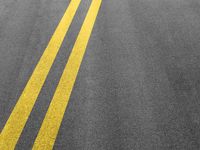
Refer to figure.
What does the marking on the given figure indicate on a taxiway?
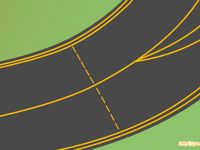
Refer to figure.
ICAO Annex 14 Volume I - Aerodrome Design and Operations
7.2 Non-load-bearing surfaces
Application
7.2.1 Shoulders for taxiways, runway turn pads, holding bays and aprons and other non-load-bearing surfaces which cannot readily be distinguished from load-bearing surfaces and which, if used by aircraft, might result in damage to the aircraft shall have the boundary between such areas and the load-bearing surface marked by a taxi side stripe marking.
Characteristics
7.2.3 Recommendation.— A taxi side stripe marking should consist of a pair of solid lines, each 15 cm wide and spaced 15 cm apart and the same colour as the taxiway centre line marking.
The purpose of these markings is to clearly distinguish the load-bearing pavement from adjacent surfaces that are not designed to support the weight of an aircraft.
Beyond the taxiway edge markings, the surface may:
- have insufficient pavement strength,
- contain soft ground or shoulders,
- or be structurally unsuitable for aircraft operations.
As a result, if an aircraft moves beyond these markings, it may suffer landing gear damage, structural stress or even partial pavement collapse or excursion. Taxiway edge markings therefore act as a visual warning limit for pilots. They indicate the safe lateral boundary of the taxiway surface
Taxiway edge markings = boundary between load-bearing and potentially non-load-bearing surfaces
If the aircraft crosses beyond them, structural damage to the aircraft may occur.
Your Notes (not visible to others)
This question has appeared on the real examination, you can find the related countries below.
-
Austro Control15
-
Germany11
-
Finland3
-
Switzerland3
-
Greece2
-
Iceland2
-
Lithuania2
-
Poland2
-
Azerbaijan1
-
Czech Republic1
-
Denmark1
-
Luxembourg1
-
Netherlands1
-
Portugal1
-
Serbia1
-
Spain1


 Use Keyboard Shortcuts
