

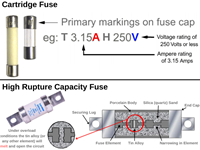
Refer to figure.
Fuses and circuit breakers aim to protect every electrical circuit. They prevent the maximum power rating of a component to be exceeded by breaking the circuit if the current increases above that rating. Unlike circuit breakers, fuses cannot be reset after they break the circuit. There’re 3 types of fuses commonly used in electrical circuits:
- Cartridge fuse – tubular glass or ceramic body, 2 brass end caps and a tinned copper wire (or silver wire, or pure zinc).
- High rupture capacity (HRC) – designed for high current rated equipment.
- Current limiter fuse – high melting point fuses allowing them to carry a significant overload current before rupturing.
All fuses have a current-specific rating (in amperes) that will indicate the maximum current they will be able to carry continuously or intermittently without excessively heating and rupturing. The rating of a fuse is designed so that it is not less than the current normally flowing in the circuit, but it ruptures just slightly below the safety limit of the equipment used. A fuse simply consists of a type of wire, as described above, that has a low melting point. As it is placed in series, the excessive electrical load will melt the wire and rupture the flow of current, should it be higher than the fuse’s ampere rating engraved upon it.
Your Notes (not visible to others)
This question has appeared on the real examination, you can find the related countries below.
-
Lithuania3
-
Sweden2
-
Hungary1
-
Slovakia1
-
United Kingdom1


 Use Keyboard Shortcuts
