

In normal flight operations, what is the correct position of the bleed air switches?
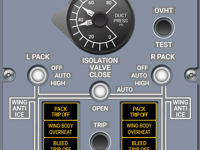
Refer to figure.
Bleed air switches control bleed air valves, which as the valves which allow bleed air, taken from the compressors of the engines/APU to enter the aircraft's pneumatic system and provide pneumatic source for consumers.
When a bleed switch is ON, the valve is OPEN and that engine/APU is providing hot, high pressure bleed air to the system, and this may be used for air conditioning/pressurisation, anti/de-icing, etc.
In normal operations, engine bleed switches are left ON usually, as they are required to be open for everything other than a bleeds-off take-off (where engine bleeds are switched off to provide a little extra thrust. Even when the engines are off, in some aircraft types, the engine bleeds may remain open, as there is no danger in this, and they are required to be open again on engine start. They may be switched off for bleeds-off take-offs or landings for performance considerations, or due to a non-normal requirement such as fumes in the cabin, engine failure, etc.
APU bleed switches, on the other hand, are usually in the OFF position for over 90% of the time, but are commonly switched ON to provide APU bleed air supply during engine start and for air conditioning on the ground (when engines are off).
As for the other option, it is rare (and does not occur in normal operations) to fly with one engine bleed switch ON and the other OFF. This would only be the case if a failure had occurred.
Your Notes (not visible to others)
This question has appeared on the real examination, you can find the related countries below.
-
Austro Control13
-
Germany12
-
Greece5
-
Italy5
-
Poland5
-
Romania3
-
Denmark2
-
Iceland2
-
Ireland2
-
Luxembourg2
-
Portugal2
-
Slovakia2
-
Spain2
-
Croatia1
-
Hungary1
-
Lithuania1
-
Malta1
-
Sweden1
-
United Kingdom1


 Use Keyboard Shortcuts
