

Which statement is correct regarding the definition of the Take-off Decision Point, TDP, for Performance Class 1 helicopter operations?
-
A
The take-off decision point, TDP, is the first point from which a continued take-off capability is assured within the RTODAH and is the last point in the take-off path from which a rejected take-off is assured within the TODAH.
-
B
The take-off decision point, TDP, is the first point from which a continued take-off capability is assured within the TODAH and is the last point in the take-off path from which a rejected take-off is assured within the RTODAH.
-
C
The take-off decision point, TDP, is the last point from which a continued take-off capability is assured within the TODAH and is the first point in the take-off path from which a rejected take-off is assured within the RTODAH.
-
D
The take-off decision point, TDP, is the first point from which a rejected take-off capability is assured within the TODAH and is the last point in the take-off path from which a continued take-off is assured within the RTODAH.
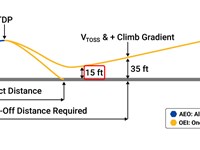
Refer to figure.
1. According to EASA AIROPS - ANNEX I - Definitions:
- Take-off Decision Point (TDP) means the point used in determining take-off performance from which, an engine failure having been recognised at this point, either a rejected take-off may be made or a take-off safely continued.
- Take-Off Distance Available (TODAH) in the case of helicopters means the length of the final approach and take-off area plus, if provided, the length of helicopter clearway declared available and suitable for helicopters to complete the take-off.
- Take-Off Distance Required (TODRH) in the case of helicopters means the horizontal distance required from the start of the take-off to the point at which take-off safety speed (VTOSS), a selected height and a positive climb gradient are achieved, following failure of the critical engine being recognised at the TDP, the remaining engines operating within approved operating limits.
- Rejected Take-Off Distance Available (RTODAH) means the length of the final approach and take-off area declared available and suitable for helicopters operated in Performance Class 1 to complete a rejected take-off.
- Rejected Take-Off Distance Required (RTODRH) means the horizontal distance required from the start of the take-off to the point where the helicopter comes to a full stop following an engine failure and rejection of the take-off at the take-off decision point.
2. According to CAT.POL.H.205 - Take-off (PC1): The helicopter is assumed to accelerate down the FATO (runway) outside of the height-velocity (H-V) diagram:
- If the helicopter has an engine failure before TDP, it must be able to land back on the FATO (runway) without damage to helicopter or passengers.
- If there is a failure at or after TDP the aircraft is permitted to lose height — providing it does not descend below a specified height above the surface (usually 15 ft if the TDP is above 15 ft).
Your Notes (not visible to others)
This question has appeared on the real examination, you can find the related countries below.
-
Austro Control1
-
Czech Republic1
-
France1
-
Poland1


 Use Keyboard Shortcuts
Use your keyboard for faster navigation
