

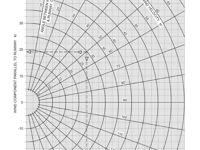
Refer to figure.
A helicopter Pilot extracts from the Aircraft Flight Manual that the maximum crosswind component is 17 kt during approach/landing. If the wind is 270/20kt, how many degrees to the left or right relative to the wind direction may the approach/landing direction be without exceeding the crosswind limit?
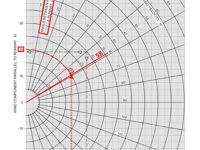
Refer to figure.
The figure helps to determine the Head/Tailwind and Crosswind Components.
For this question determine the Maximum Angle Between Wind Direction and Approach/Landing Direction with the following manner:
- Enter the graph from the horizontal axis with Maximum Crosswind Component 17 kt and draw a vertical line.
- Follow the arc of 20 kt as indicated until crossing the vertical line.
- The intersection lies on the radius 58º, which is the Maximum Angle Between the Wind Direction and the Approach/Landing Direction.
That means that, the helicopter may has its approach/landing direction left or right relative to the wind direction not more than 58º to stay within the crosswind limit of 17 kt, i.e the helicopter's approach/landing direction should be between 270º - 58º = 212º and 270º + 58º = 328º.
NOTES:
This graph is not in CAP 758, but actually in CAP 698 for fixed-wing performance and according to feedback it has appeared in exam questions.
Your Notes (not visible to others)
This question has appeared on the real examination, you can find the related countries below.
-
Austro Control5
-
Switzerland2
-
Bulgaria1
-
Czech Republic1
-
Germany1


 Use Keyboard Shortcuts
