

A pilot is approaching a runway which is narrower than the one at their home base and has more of an upslope. What visual impression may the pilot get during the approach, and how should they proceed safely?
-
A
The pilot may have the impression that they are above the correct approach path, resulting in an increased rate of descent and possible undershoot. They should believe their instruments.
-
B
The pilot will feel that they are further out on the descent path and may reduce thrust too late, resulting in an overshoot. They should pay careful attention to their approach speed.
-
C
The pilot may believe that they are flying too fast, resulting in an early thrust reduction and lack of energy. They should be careful not to reduce below the specified approach speed.
-
D
The pilot will be able to correctly assess their relative position and speed, but may be unaware of the increased landing distance required. They should consult their performance charts before the flight to ensure that the aircraft can safely land at the aerodrome.
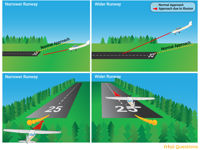
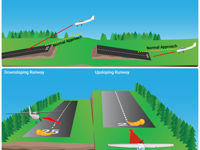
Refer to figures.
One of the expectations a pilot has on final approach is the size of the runway in front of them. Deviations from a familiar runway size/slope can cause them to misjudge the remaining distance along the glide path.
A narrower-than-usual runway can create an illusion that the aircraft is higher than it actually is. If the pilot believes this illusion, they might pitch the aircraft’s nose down to lose altitude. Landing will also be hard in this case, because they will possibly flare late, expecting the runway to be larger in their windows, touching down with a large vertical speed.
Furthermore, when approaching a runway with an upslope, the pilot views it at an increased angle, causing him to assume that he/she is higher above the runway than they actually are. The angle looks the same as being too high to a flat runway. The pilot might then increase their rate of descent and land short of the runway.
As a result, the combination of a narrower runway with an upslope can easily make the pilot believe that they are actually high on approach. To correct this perception, they may descent too low, with the risk of landing short of the runway. Trusting their flight instruments should counteract this illusion.
Your Notes (not visible to others)
This question has appeared on the real examination, you can find the related countries below.
-
France7
-
Austro Control3
-
Spain3
-
Poland2
-
Azerbaijan1
-
Croatia1
-
Czech Republic1
-
Germany1
-
Hungary1
-
Iceland1
-
Italy1
-
Lithuania1
-
Slovakia1
-
Thailand1
-
United Kingdom1


 Use Keyboard Shortcuts
