

Why is ear discomfort typically greater during descent than during ascent?
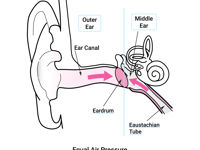
Refer to figure.
EUSTACHIAN TUBE
The eardrum is a thin, flexible membrane that separates the outer ear from the middle ear. Air that comes to the eardrum from the outer ear side is environmental air and immediately adapts to pressure changes as we climb or descent. The air that exists from the other side of the eardrum is ‘trapped’ inside the middle ear and does not change pressure automatically. However, there is a tube that connects the middle ear to the back of the throat called the Eustachian tube. This tube is normally closed, and opens when necessary to help the middle ear adapt to any changes in atmospheric pressure.
Air that enters through our throat as we breath is environmental air that adapts to pressure changes as we climb or descent. When the Eustachian tube opens, it allows the air from the throat to enter the middle ear and causes the air of the middle ear to adapt to any pressure changes. This process ensures that the same pressure exists at both sides of the eardrum.
- During a climb, outside air pressure decreases, so the pressure inside the middle ear becomes relatively higher. This excess pressure pushes air out of the middle ear through the Eustachian tube, and the tube opens quite easily in this direction. That is why pressure equalization during climb is usually automatic and not uncomfortable.
- During a descent, outside air pressure increases, so the pressure in the middle ear becomes relatively lower. To equalize, air must be pushed into the middle ear through the Eustachian tube, but the tube does not open as easily in this direction. It often requires swallowing, yawning or Valsalva tehnique to force it open, and if it does not open effectively, pressure builds up, causing discomfort or pain.
Let's examine the given options:
Because pressure changes are faster during descent. → INCORRECT. The pressure changes depend on the rate of climb or the rate of descent. The rate of descent is not always higher than the rate of climb.
Because the middle ear produces more pressure during descent. → INCORRECT. The middle ear does not produce pressure. Pressure differences occur due to changes in external atmospheric pressure, not because the ear generates pressure.
Due to the specific shape of the Eustachian tube. → CORRECT. The Eustachian tube opens easily during climb due to its structure and equalizes harder during descent.
Because oxygen levels decrease during descent. → INCORRECT. Oxygen levels increase during descent but they are not the cause of ear pain. Ear discomfort is related to pressure differences, not oxygen availability.
Your Notes (not visible to others)
This question has appeared on the real examination, you can find the related countries below.


 Use Keyboard Shortcuts
