

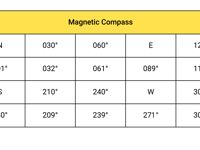
Refer to figure.
When flying a magnetic heading of 273°, what is the deviation?
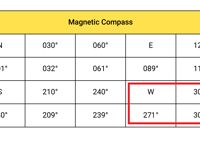
Refer to figure.
EASA learning objective 022.03.02.01.05 states: 'Demonstrate the use of deviation values (either given as E/W or +/–) from a compass deviation card to calculate: compass heading to magnetic heading; magnetic heading to compass heading.'
Due to the magnetic fields generated by an aircraft there's often a difference between the aircrafts actual magnetic heading and where the direct reading compass points to (Compass Heading)! The difference between Compass Heading and Magnetic Heading is called Deviation and it's expressed as a number of degrees East or West or as a positive or negative number (Easterly is positive and Westerly is negative).
Compass deviation can be minimised by measuring the deviations during a 'compass swing' and compensating for the aircrafts magnetic field by adjusting small magnets in the direct reading compass. Deviation can rarely be completely compensated for on all headings so a deviation card is mounted near the compass to show the residual deviation.
The figure shows an example of a deviation card annotated with 'For' and 'Steer' columns which avoids confusion over which way to apply the heading correction. For example 'For' a magnetic heading of 060° 'Steer' a compass heading of 061°. Headings inbetween the figures in the table have to be interpolated. Other deviation cards my be annotated 'To Fly' and Steer' but the principle is the same. The difference between the magnetic heading and compass heading required is 1° so that's the amount of deviation but is it East or West?
An easy way to work this out is to remember the phrase 'Deviation East, Compass Least. Deviation West, Compass Best. 'Best' refers to the higher number of the two figures and 'Least' to the lower. Applying this to figure in the question, the compass 'Steer' heading of 061° is bigger than 060° so applying 'Deviation West, Compass Best' tells us that the deviation is 1°W.
In the question the required magnetic heading is 273°, to work out the required compass heading to 'STEER' we need to interpolate the deviation from the ‘For’ headings of W (Steer 271) and 300°(Steer 302). As you can see there is 1° of deviation on West but 2° on 300°, therefore interpolation indicates a deviation of 1° on a magnetic heading of 273°. Using the phrase ‘Deviation East, Compass Least. Deviation West, Compass Best’ we can see that the respective ‘Steer’ compass headings are bigger than the required magnetic headings which indicates Westerly deviation.
Therefore ‘For’ a magnetic heading of 273° you need to ‘Steer’ a compass heading of 274° which is a deviation of 1°W
An alternative method is to use the 'CDMVT' (Cadburys Dairy Milk Very Tasty) method to construct a table. Enter the compass and magnetic headings, the deviation is the difference between the two figures and the arrow always point to the higher number which is on the West side of the table.
| WEST | Compass | Deviation | Magnetic | Variation | True | EAST | ||
| 274 | <---- 1 | 273 |
Your Notes (not visible to others)
This question has appeared on the real examination, you can find the related countries below.
-
Germany6
-
Austro Control4
-
Spain3
-
Switzerland2
-
Greece1
-
Iceland1
-
Romania1


 Use Keyboard Shortcuts
