

Which of the following describes how air very close to the surface is warmed?
The air is heated by…
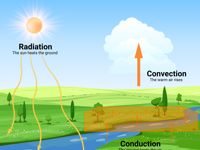
Refer to figure.
Air very close to the Earth’s surface is warmed by conduction. Conduction is one of the three main ways heat energy moves, alongside radiation and convection, and occurs when heat is transferred through collisions between neighbouring molecules.
During the day, sunlight heats the ground, and the warm ground then directly transfers heat to the air molecules in contact with it. Since air is a poor conductor, most energy transfer by conduction occurs only a few centimetres above the surface, making it the main way the lowest layer of air is heated. Later, convection can carry this warmed air upward, but the initial heating of the air right above the ground is due to conduction. At night, the process reverses, the ground cools and the heat flows from the warmer air directly above to the cooler ground via conduction.
Radiation. → INCORRECT. Radiation transfers heat through electromagnetic waves, like sunlight traveling through space. While it heats the ground, it does not directly warm the air near the surface because air molecules absorb very little solar radiation.
Shortwave radiation. → INCORRECT. This is the form of solar energy that heats the Earth’s surface, not the air directly. The air only warms when it comes into contact with the hot ground via conduction.
Convection. → INCORRECT. Convection moves heat by the rising of warm air and sinking of cool air. While it distributes heat through the atmosphere, it does not directly heat the air in contact with the ground. The air must first be warmed by conduction before convection can carry it upward.
Your Notes (not visible to others)
This question has appeared on the real examination, you can find the related countries below.
-
Azerbaijan2
-
Slovakia2
-
Spain1


 Use Keyboard Shortcuts
