

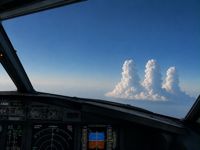
Refer to figure.
You can expect (1) _____ turbulence, and (2) _____ icing.
You can expect (1) _____ turbulence, and (2) _____ icing.
Towering cumulus signifies a relatively deep layer of unstable air. TCU indicates the presence of ‘thermals’, and may grow into Cb if conditions are right. Towering Cumulus(TCU) clouds can lead to the development of thunderstorms, squalls and in extreme cases funnel clouds (water spouts or tornadoes). Individually and collectively they pose a major hazard to aviation operations on the ground and in the air due to the likelihood of:
- severe turbulence,
- severe icing
Your Notes (not visible to others)
This question has appeared on the real examination, you can find the related countries below.
-
Austro Control27
-
Germany20
-
Poland10
-
Spain8
-
Greece7
-
Sweden7
-
Switzerland4
-
Czech Republic3
-
Hungary3
-
Italy3
-
Portugal3
-
Finland2
-
Norway2
-
Slovakia2
-
Denmark1
-
Iceland1
-
Ireland1
-
Latvia1
-
Romania1


 Use Keyboard Shortcuts
Use your keyboard for faster navigation
