

Given:
Distance from departure to destination: 3750 NM
Safe Endurance: 9.5 h
True Track: 360
W/V: 360/50
TAS: 480 kt
What is the distance of the PSR from the departure point?
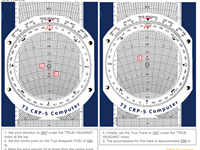
Refer to figure.
Note: Since the terms PET and PSR are not present in EASA Air Ops, these questions are less likely to appear in the exam.
The Point of Safe Return (PSR) is the last point on a route at which it is possible to return to the departure airfield arriving back with the required fuel reserves still available in the tanks. If the pilot chooses to continue past the PSR, he is now committed to landing at your destination.
Time (to PSR) = E x H / (0 + H)
- Where, E = Safe endurance based on available fuel; H = Ground speed home; 0 = Ground speed out
Solving from Heading (HDG) & Ground Speed (GS), knowing WV, TAS and required track.
1. Set wind direction to 360º under the "TRUE HEADING" index at the top.
2. Set the center point on the True Airspeed (TAS) of 480 kt.
3. Mark the wind velocity 50 kt down from the centre point.
4. Initially, set the True Track under the "TRUE HEADING" index.
- GS home: 180º
5. The groundspeed for this track is approximately 530 kt.
- GS out: 360º
5. The groundspeed for this track is approximately 430 kt.
We can now apply the formulas:
Time (to PSR) = E x H / (0 + H)
Time to PSR = 9.5 x 530 / (430 + 530) = 5.244 h
To find the distance from the departure airport to the PSR, we simply multiply the time to PSR by the GS OUT: 5.244 hrs × 430 kts = 2255 NM.
Your Notes (not visible to others)
This question has appeared on the real examination, you can find the related countries below.


 Use Keyboard Shortcuts
