

The correct Pilot action to recover from a Vortex Ring State (settling with power) is?
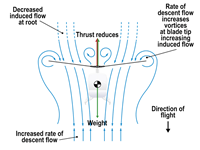
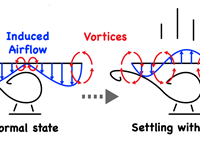
Refer to figures.
Vortex Ring State (settling with power) is a hazardous flight condition which you need to understand so that you can best avoid it. It is best described as a flight condition where the disc of a descending helicopter comes into contact with its own turbulent, and compressed, wake. The result is a marked loss of thrust which can lead to an even greater, and possibly uncontrollable rate of descent.
The pilot will recognize Vortex Ring State by feeling the helicopter having vibrations, increased rate of descent, random yaw, pitch, roll and loss of controls. This stage is unstable and can lead to a catastrophic situation. Factors increasing the risk of Vortex Ring State are density altitude, high gross weight and low RRPM.
The conditions for Vortex Ring State to exists are:
- High rate of descent (> 300 ft).
- Airspeed below translational lift (<30 kt).
- Power applied.
To recover from Vortex Ring State the pilot must:
- Apply forward cyclic and ease tip path plane to horizon.
- Slightly lower collective (if height permits).
- Maintain heading with pedals.
- When having positive Airspeed, apply power and climb out.
Your Notes (not visible to others)
This question has appeared on the real examination, you can find the related countries below.


 Use Keyboard Shortcuts
