

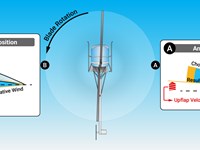
Refer to figure.
Dissymmetry of lift is unequal amounts of lift generated on the advancing side versus the retreating side of the main rotor during forward flight. A good way to understand the dissymmetry of lift is to understand the Lift formula and the relation of the rotor speed for advancing and retreating sides.
- L = CL x ½ 𝜌 x V2 x S
- L = lift
- CL = coefficient of lift
- ½ 𝜌 = half the density of the air
- V2 = velocity of the rotor squared
- S = surface of the blade
Knowing the above we can derive that the advancing blade speed is increased in forward flight and therefore, lift is increased while the retreating blade speed is reduced as the helicopter moves forward in flight leading to a reduction of lift.
If the condition was allowed to exist, the helicopter would flap back and roll to the retreating blades side. This is prevented by allowing for blade flapping leading to equalised lift on both advancing and retreating sides.
As the blade moves thru air on the advancing side, the blade flaps up leading to a lowering of angle of attack. Therefore, there is a reduction of the coefficient of lift as it is affected by angle of attack and the shape of the blade. The coefficient of lift is reduced while the velocity of the blade is increased, keeping the lift more constant.
As the blade moves through the air on the retreating side, the blade flaps down, due to a loss of the relative airflow, so it is less influenced by the induced flow, leading to an increased angle of attack and as a result, the relative airflow gets an upward component.
Your Notes (not visible to others)
This question has appeared on the real examination, you can find the related countries below.
-
United Kingdom5
-
Pakistan2
-
Czech Republic1
-
Poland1
-
Spain1


 Use Keyboard Shortcuts
