

What is the function of the strake on the tailboom?
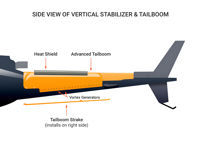
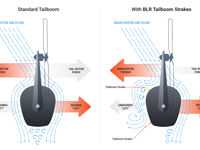
Refer to figures.
The main rotor of a helicopter accelerates as it goes around a curved tailboom. This accelerates airflow and results in increased pressure that acts against the tail boom, causing a force disadvantageous to controlling the helicopter. Tailboom Strakes provide unprecedented levels of stability, control and safety by reducing undesired lift. Tailboom Strakes are the most cost-effective, multi-functional, value-added modification ever developed for single-rotor helicopters with enclosed tailbooms.
They work by organizing and controlling rotorwash, reducing undesired sideways lift on one side of the tailboom depending on the direction of the rotor system. By reducing turbulence under the tailboom, tailboom Strakes reduce tail rotor pedal reversals by up to 38 percent.
Therefore, with strakes installed the directional stability is improved drastically during hover.
Your Notes (not visible to others)
This question has appeared on the real examination, you can find the related countries below.
-
Austro Control1
-
Czech Republic1
-
Spain1


 Use Keyboard Shortcuts
