

Assuming the same conditions, what manifold pressure (MAP) is required for a piston-engined helicopter to hover out of ground effect (HOGE), if it requires 24 in.Hg in a hover in ground effect (HIGE)?
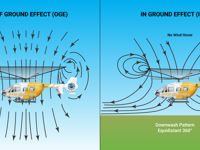
Refer to figure.
If the helicopter is Hovering In Ground Effect (HIGE), the downwash meets the ground and is forced to diverge sharply. This increases the pressure in the wake below the helicopter. This increased pressure opposes and, thus, reduces the Induced Airflow (IAF).
The decreased IAF increases the effective Angle of Attack (AoA) and increases the Total Rotor Thrust (TRT). So, a lower pitch angle is required, to maintain a stable HIGE. The lower pitch angle tilts the total reaction force more forward, generating less rotor drag. As a result, a lower collective setting and power are required to counteract the rotor drag.
Conversely, if the helicopter is Hovering Outside Ground Effect (HOGE), the downwash continues to flow until it is outside the influence of the high pressure region under the rotor disc and slows as it loses its energy to the surrounding air. Compared to a HIGE, the pressure wake below the helicopter is decreased and does not contribute to the IAF decrease. Instead, the IAF is increased, so the effective AoA decreases.
Thus, to maintain a stable HOGE, a greater pitch angle is required, tilting the total reaction force backwards, generating more rotor drag. As a result, a greater collective setting and power are required to compensate for the increased rotor drag.
Therefore, if a piston-engined helicopter requires 24 in.Hg in a hover in ground effect (HIGE), then it requires more than 24 in.Hg MAP to hover out of ground effect (HOGE).
Your Notes (not visible to others)
This question has appeared on the real examination, you can find the related countries below.
-
Austro Control2
-
Spain1


 Use Keyboard Shortcuts
