

The uneven pattern of the induced flow in forward flight…
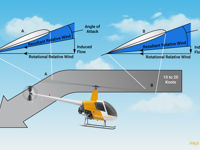
Refer to figure.
There are two parts of wind passing by a rotor blade, the horizontal part known as relative wind and the vertical part known as induced flow (perpendicular to the rotor disc). The horizontal part is caused by the rotor blades turning plus the helicopter's movement through the air. The vertical part is caused by the air being deflected downward thru the rotor blades.
Induced flow is the air going through the rotor system from top to bottom and is higher during an out of ground effect hover with no wind and slightly less while hovering in ground effect due to ground cushion effect. When wind is present the relative wind is stronger and therefore reduces the induced flow.
Resultant relative wind is a product of induced flow and relative wind. The angle of attack (AoA) is measured between the resultant relative wind and the chord line of the rotor blade. In the hover the induced flow will be the highest and AoA will be the lowest, as the helicopter starts moving into forward flight the induced flow will gradually reduce and relative airflow will increase leading to the AoA increasing.
When a helicopter is flying straight and level, the rotor disc is tilted forward and therefore will have the lowest amount of induced flow at the tip of the forward blade and highest at the tip of the rear blade.
Your Notes (not visible to others)
This question has appeared on the real examination, you can find the related countries below.


 Use Keyboard Shortcuts
