

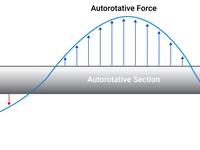
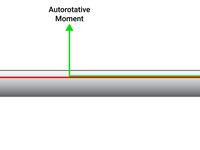
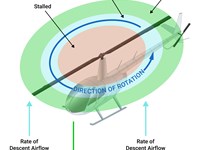
Refer to figures.
During autorotation, the rotor disc operates in three defined regions:
- Stalled
- Driving (Autorotative)
- Driven
and the balance of forces changes spanwise.
At the blade root and tips, lift is produced, but at the expense of a lot of drag which opposes the rotor rotation. Only in the central autorotative region, where the L/D ratio is optimal, autorotative force is given to the rotor blades.
The sum of all the autorotative (driving) forces in the autorotative section can be represented by one vector, which will be near the middle of the autorotative section. This force creates a moment about the rotor hub. The further outboard the force is acting, the greater the moment.
Similarly, in the stalled region, the moment of drag will be very small indeed. On the other hand, the drag created at the tip of the blade has a much larger moment. So, the total moment of drag is probably somewhere near the blade tip.
What determines whether the rotor can be driven forward, is the net effect of the two moments. The autorotative moment must be larger than the drag moment and it must be a little bit larger still to overcome the additional mechanical drag caused by the gearbox.
Provided that the autorotative moment exactly counterbalances the drag moment plus the mechanical drag, the rotor will rotate at constant RPM, neither accelerating nor decelerating.
Your Notes (not visible to others)
This question has appeared on the real examination, you can find the related countries below.


 Use Keyboard Shortcuts
