

-
A
The true bearing of the aircraft from the station, magnetic bearing of the aircraft from the station, true heading to the station (with a wind correction angle applied), and magnetic heading (with a wind correction angle applied) to the station.
-
B
The true bearing of the aircraft from the station, magnetic bearing of the aircraft from the station, true heading (in no wind) to the station, and magnetic heading (in no wind) to the station.
-
C
The true bearing of the aircraft from the station, true heading (in no wind) to the station, aircraft position in relation to the station, and distance from the station.
-
D
The magnetic bearing of the aircraft from the station, magnetic heading to the station, aircraft position in relation to the station, and distance from the station.
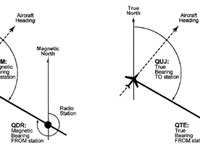
Refer to figure.
Direction finding (DF) is a basic form of radio navigation that is rarely used nowadays, as most aircraft have superior navigation equipment available and many airfields have abandoned their measuring equipment as it was rarely used, needed maintenance and specialised training for staff. The only equipment needed in an aircraft is a radio. The pilot would make a transmission, and the ground station would measure the direction of the received transmission and relay the bearing information to the aircraft in whichever format the pilot had asked for; magnetic or true, to or from the station.
As seen in the figure there is a system of abbreviations that indicates what kind of bearing is described.
QDM = Magnetic bearing to the station
QDR = Magnetic bearing from the station
QUJ = True bearing to the station
QTE = True bearing from the station
This question is very badly written but it is written as reported! The only information that can be supplied by a direction finding station is bearing, either magnetic or true, as the ground station can measure the direction from which the aircraft's radio transmission is being received, and it can apply local variation if required. (Variation in most parts of the world is known, and is constant over a relatively large area, and if you can receive and transmit on a VHF radio frequency it is likely that you are within a range of the ground station where variation is known.) The ground station has no way of knowing your aircraft's heading, however, as this depends on wind. Knowing this, technically none of the answers is correct. However, we can still answer the question if we assume the question writer has used the wrong word - heading - instead of bearing.
DF ground stations have no way of knowing the wind at your location, as wind varies greatly with height and over short distances. Any answer that includes a wind correction can be discounted.
DF ground stations have no way of knowing how far away you are, they cannot provide distance information. They can only measure a bearing. Any answer that includes distance can be discounted.
A single DF station has no way of working out your position, all it can tell is that you are somewhere along a bearing line. To get a position fix you would at least two DF stations, but this question specifically asks for a single station.
Knowing this, it is very easy to eliminate three answers for being completely wrong on fundamental principles, and we then must assume the word heading was used instead of bearing. If seen in an exam, this should be appealed in its current wording.
Your Notes (not visible to others)
This question has appeared on the real examination, you can find the related countries below.
-
Austro Control7
-
United Kingdom3
-
Ireland1
-
Poland1


 Use Keyboard Shortcuts
