

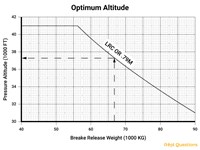
Refer to figure.
Given the following information for a Commercial Air Transport operation, calculate the maximum possible Extra Fuel to be uplifted, if the Commander wants to climb directly to the optimum altitude of 37 000 ft.
Cruise speed: 0.79 M
Maximum Zero Fuel Mass MZFM: 62 731 kg
Actual Zero Fuel Mass AZFM: 59 031 kg
Regulated Take-Off Mass RTOM: 76 000 kg
Maximum Landing Mass MLM: 66 360 kg Fuel
Tank Capacity: 16 000 kg
Taxi Fuel: 240 kg
Trip Fuel: 4761 kg
Minimum Block Fuel: 8000 kg
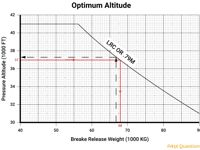
Refer to figure.
The maximum allowable take-off mass is the lower of:
- RTOM: 76 000 kg
- MLM + Trip Fuel: 66 360 + 4 761 = 71 121 kg
However, the commander wants to climb directly to the optimum altitude of FL370, so the take-off mass may be further limited by the graph.
Using the graph:
- Start at 37 000 ft on the vertical axis and move horizontally until you reach the LRC 0.79 M line.
- From this intersection, move vertically down to the horizontal axis to read the corresponding Brake Release Weight, which is approximately 68 000 kg.
Therefore, although the structural/performance limit is 71 121 kg, the graph limits the take-off mass to 68 000 kg if the aircraft is to climb directly to FL370.
The minimum block fuel is 8 000 kg, therefore:
Take-off fuel = Block fuel − Taxi fuel = 8 000 − 240 = 7 760 kg
Finally:
Extra Fuel = Maximum Take-off Mass − (Actual Zero Fuel Mass + Take-off Fuel) = 68 000 − (59 031 + 7 760) = 1 209 kg
Your Notes (not visible to others)
This question has appeared on the real examination, you can find the related countries below.
-
Austro Control9
-
United Kingdom7
-
Greece3
-
Lithuania2
-
Poland2
-
Hong Kong1
-
Ireland1
-
Malaysia1
-
Portugal1
-
Sweden1


 Use Keyboard Shortcuts
