

On a Lambert conformal projection the chart convergency between two positions depends on...
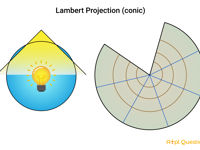
Refer to figure.
|
PROPERTIES OF A LAMBERT CHART |
|
|
Scale |
Correct on the standard parallels. Contracted within the standard parallels. (least then 1% at parallel of origin). |
|
Orthomorphic |
Yes. All charts used for navigation must be. |
|
Graticule |
Meridians are straight lines, originating from the pole. Parallels are arcs of circles, centred at the pole. |
|
Parallel of Origin |
Mathematical basis of projection. Assumed to be halfway between the 2 standard parallels. |
|
Chart Convergence |
Constant across the chart = Earth Convergence. |
|
Rhumb Lines |
Meridians are straight lines. All other Rhumb Lines are concave to the pole (i.e. parallels of latitude). |
|
Great Circles |
Meridians are straight lines. |
Your Notes (not visible to others)
This question has appeared on the real examination, you can find the related countries below.
-
Malaysia2
-
Poland2
-
Ireland1
-
Lithuania1
-
United Kingdom1


 Use Keyboard Shortcuts
