

The Vestibular Apparatus consists of the…
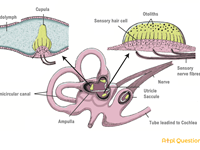
Refer to figure.
VESTIBULAR SYSTEM
The vestibular system, located in the inner ear, consists of the vestibule and three semicircular canals.
The utricle and saccule organs within the vestibule are responsible for the perception of gravity and linear acceleration. A gelatinous substance within the utricle and saccule is coated with a layer of tiny grains of limestone called otoliths. Movement of the vestibule causes the otoliths to shift, which in turn causes hair cells to send out nerve impulses to the brain for interpretation.
The semicircular canals are oriented in three planes, each at 90° angle to the other two. This allows them to sense yaw, pitch and roll. The canals are filled with fluid, and each has a gelatinous structure called cupula. When the body changes position, the canals move but the fluid lags behind, causing the cupula to lean away from the movement. Movement of the cupula results in deflection of hair cells that stimulate the vestibular nerve. This nerve transmits impulses to the brain, which interprets the signals as motion about an axis.
Your Notes (not visible to others)
This question has appeared on the real examination, you can find the related countries below.
-
Poland4
-
Austro Control3


 Use Keyboard Shortcuts
