

If the climb speed schedule is changed from 280/.74 to 290/.74 the new crossover altitude will be
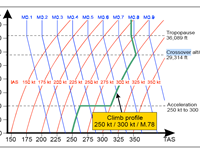
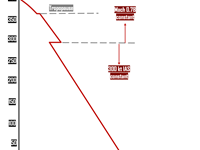
Refer to figure.
The Crossover Altitude is the altitude where a specific Indicated Airspeed (IAS) becomes a specific Mach number (M). It is the altitude where a specified IAS and Mach number represent the same TAS.
Below the Crossover Altitude, the climb is performed maintaining a constant IAS. Whereas above the Crossover Altitude, the climb is performed maintaining a constant Mach number. At the Crossover Altitude, there is one value of TAS which corresponds to the given Mach number.
Higher IAS during constant speed climb => lower cross over
Slower IAS during constant speed climb => higher cross over
The Crossover Altitude is the altitude where a specific Indicated Airspeed (IAS) becomes a specific Mach number (M). It is the altitude where a specified IAS and Mach number represent the same TAS.
Below the Crossover Altitude, the climb is performed maintaining a constant IAS. Whereas above the Crossover Altitude, the climb is performed maintaining a constant Mach number. At the Crossover Altitude, there is one value of TAS which corresponds to the given Mach number.
- During the initial climb (below the Crossover Altitude), when maintaining a constant IAS, both the Mach number and the TAS increase.
=> when climbing at 280 kts IAS, the changeover altitude will be around 30 000ft. Now, if IAS is 10 kt faster - increases to 290 kt => the aircraft will reach M 0.74 faster and, consequently, the crossover point will be reached at a lower altitude (around 28 000ft)
Higher IAS during constant speed climb => lower cross over
Slower IAS during constant speed climb => higher cross over
Your Notes (not visible to others)
This question has appeared on the real examination, you can find the related countries below.
-
Poland4
-
Austro Control1
-
Ireland1
-
Italy1


 Use Keyboard Shortcuts
Use your keyboard for faster navigation
