

Determine the thrust in N if you are in a 30 degree climb, given:
Lift: 127 436 N
Drag: 120 500 N
Mass: 15 000 kg
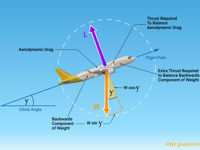
Refer to figure.
Consider an aircraft in a straight steady climb along a straight flight path inclined at an angle (γ) to the horizontal. γ (gamma) is the symbol used for climb angle. The forces on the aircraft consist of Lift, normal to the flight path; Thrust and Drag, parallel to it; and Weight, parallel to the force of gravity.
Weight is resolved into two components: one opposite Lift (W cos γ) and the other acting in the same direction as Drag (W sin γ), backwards along the flight path. The requirements for equilibrium are:
- Thrust must equal the sum of Drag plus the backwards component of Weight (T = D + W sin γ); and
- Lift must equal its opposing component of Weight (L = W cos γ)
For equilibrium at a greater angle of climb, the Lift required will be less, and the backwards component of Weight will be greater.
With regards to this question,
Weight is a force = mass X acceleration due to gravity (ICAO Annex 5, ATT B-3)
- W = 15 000 kg x 9.81 m/s2 = 147 150 N
- T = D + W sin γ
T= 120 500 + 147 150 sin (30°) = 194 075 N
Your Notes (not visible to others)
This question has appeared on the real examination, you can find the related countries below.


 Use Keyboard Shortcuts
