

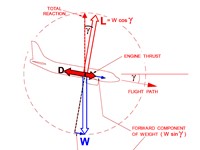
Refer to figure.
Figure 1 illustrates the forces in a steady Power-on descent.
The force of Weight is split into two components. One component (W cos γ) acts perpendicular to the flight path and is balanced by Lift, while the other component (W sin γ) acts forward along the flight path and ‘adds’ to the Thrust to balance Drag. If the nose of the aircraft is lowered with a constant Thrust setting, the increased component of Weight acting forward along the flight path will cause an increase in IAS. The increased IAS will result in an increase in Drag which will eventually balance the increased forward force of Weight and equilibrium will be re-established.
If the throttle is closed, the force of Thrust is removed, and a larger forward component of Weight must be provided to balance Drag and maintain a constant IAS. This is accomplished by lowering the nose of the airplane to increase the descent angle (γ).
In a descent Lift is less than Weight. This is because Lift only has to balance the component of Weight perpendicular to the flight path (W cos γ).
In a descent Thrust is less than Drag. This is because Weight is giving a forward component in the same direction as Thrust (W sin γ).
Your Notes (not visible to others)
This question has appeared on the real examination, you can find the related countries below.
-
Italy1
-
Serbia1


 Use Keyboard Shortcuts
