

Given the following information, where does the HSI course deviation bar appear?
Heading: 160°
VOR radial: 240°
Selected course: 250°
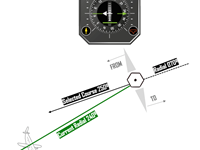
Refer to figure.
The HSI gives a pictorial representation of the navigational position of the aircraft with reference to a selected course.
In this case, the selected course is 250º, which equates to a 10º displacement from the current radial 240º.
Now, if the aircraft was flying away from the station, along radial 240º, the CDI needle would be fully deflected to the right. This would indicate that the selected radial was located to the right of the aircraft.
However, the aircraft is actually following a heading of 160º, which means that the selected course is behind the aircraft. Therefore, the CDI indicator should be displaced behind the aircraft symbol in the instrument.
Your Notes (not visible to others)
This question has appeared on the real examination, you can find the related countries below.
-
Italy2
-
Austro Control1
-
Greece1
-
Hungary1
-
Portugal1


 Use Keyboard Shortcuts
