

When a controlled VFR flight transiting a Control Zone suffers a communications failure, what shall the pilot do?
1. Continue to fly in either VMC or IMC as meteorological conditions dictate
2. Continue to fly in VMC
3. Leave the Control Zone by the shortest route taking into account the weather conditions, obstacles and known areas of high traffic density
4. Land as soon as possible at the nearest controlled aerodrome in the Control Zone, watching for visual signals when in the aerodrome traffic circuit
5. Land at the nearest suitable aerodrome
6. Report the aircraft`s arrival by the most expeditious means to the appropriate ATS Unit
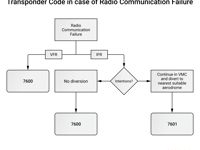
Refer to figure.
Note: Under the latest Standardised European Rules of the Air (SERA), in the event of lost comms, there is a new squawk code:
- VFR = Squawk 7600
- IFR and continuing with your IFR flight – even if you’re in VMC = Squawk 7600
- IFR in VMC and you decide to land at the nearest suitable airport instead of continuing the flight = Squawk 7601 This new code informs ATC that you are diverting and so they can plan your separation.
In case of communication failure in VMC:
- Continue to fly in VMC
- Land at the nearest suitable aerodrome
- Report your arrival by the most expeditious means to the appropriate air traffic services unit (ATSU)
- Since the intention was to cross the control zone, it is desirable to do that as it may be busy with IFR traffic. (The question says transiting)
Looking at the answer options:
1. Continue to fly in either VMC or IMC as meteorological conditions dictate → INCORRECT. Stay in VMC
2. Continue to fly in VMC → CORRECT.
3. Leave the Control Zone by the shortest route taking into account the weather conditions, obstacles and known areas of high traffic density → CORRECT.
4. Land as soon as possible at the nearest controlled aerodrome in the Control Zone, watching for visual signals when in the aerodrome traffic circuit → INCORRECT. You should land at the nearest suitable aerodrome, not necessarily the nearest controlled aerodrome.
5. Land at the nearest suitable aerodrome → CORRECT.
6. Report the aircraft`s arrival by the most expeditious means to the appropriate ATS Unit → CORRECT.
ICAO Annex 2
3.6.5 Communications
3.6.5.2 Communication failure. If a communication failure precludes compliance with 3.6.5.1, the aircraft shall comply with the voice communication failure procedures of Annex 10, Volume II, and with such of the following procedures as are appropriate. The aircraft shall attempt to establish communications with the appropriate air traffic control unit using all other available means. In addition, the aircraft, when forming part of the aerodrome traffic at a controlled aerodrome, shall keep a watch for such instructions as may be issued by visual signals.
3.6.5.2.1 If in visual meteorological conditions, the aircraft shall:
a) continue to fly in visual meteorological conditions; land at the nearest suitable aerodrome; and report its arrival by the most expeditious means to the appropriate air traffic services unit;
b) if considered advisable, complete an IFR flight in accordance with 3.6.5.2.2.
Your Notes (not visible to others)
This question has appeared on the real examination, you can find the related countries below.
-
Pakistan5
-
Hong Kong3
-
United Kingdom3
-
Sweden2
-
Austro Control1
-
Greece1
-
Italy1
-
Poland1


 Use Keyboard Shortcuts
