

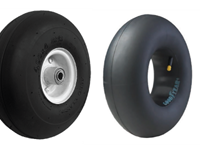
Refer to figure.
The tread of an airplane tire will wear out long before its casing (everything other than the tread). This means that the tire casing remains entirely capable of safely holding the inflation pressure to support the load of the airplane long after the tread has worn away. All the tire needs is a new tread.
Airplane tires can be expensive: there is no logical reason to scrap a tire for an aircraft when it can be safely and economically reconditioned with a new tread. This is why retreading has been standard practice in the aviation industry for decades.
The maximum retread level for the part number is set only after extensive testing and analysis. Some airplane tyres can be safely retreaded up to seven or more times, but there is always a limit and the limit is always set with an abundance of caution.
The retread process is easy to understand.
-
A worn tyre is removed from an aircraft.
-
It is sent back to a retreading firm, often a manufacturer of airplane tires.
-
When the firm receives a tire for retreading it is carefully inspected to ensure that it is safe and economical to retread.
-
The tyre is scrapped if technicians consider there to be doubt about its airworthiness.
Your Notes (not visible to others)
This question has appeared on the real examination, you can find the related countries below.
-
United Kingdom3
-
Austro Control1
-
Germany1
-
Greece1
-
Portugal1


 Use Keyboard Shortcuts
