

Consider the following situation, the rudder ratio limiter of an aircraft gets stuck in high speed/high altitude mode when decelerating for the approach. Which of the following statements is correct?
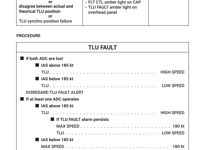
Refer to figure.
Learning Objective 021.05.01.05.05: Explain the concept of a rudder deflection limitation (rudder limiter) system and the various means of implementation (rudder ratio changer, variable stops, blow-back).
One of the problems with rudders is that they need to be very large and have a large maximum deflection for adequate directional control in the case of an engine failure during take-off or at low speeds, when there is very little airflow, but if this large rudder had a large deflection at the high cruise speeds of a jet aircraft, it could easily break the tail of the aircraft off with the extreme forces.
There are a few methods to remove this problem, rudder ratio changers, variable stops, and blow-back.
Rudder Ratio Changer: The control commands from the rudder pedals and trim control are modified by a rudder ratio changer. As the aircraft speed increases, the rudder deflection must be reduced proportionately within the range of the rudder pedal depression by the pilot => the rudder pedals move through their full range at all speeds, however, rudder deflection is reduced with increasing airspeed. This rudder ratio changer can be continuous, as described above, or can be a discreet change at a certain airspeed, like changing gears in a car.
If this automatic reduction in rudder authority is not applied and rudder is fully deflected when the aircraft is in high speed flight, the huge forces could damage the aircraft, or at least cause violent yaw/roll.
Conversely, if the rudder remains in the high-speed, low deflection mode, then there will be insufficient rudder authority to handle engine failures and crosswind landings at low speeds. This means that the approach will have added limitations, such as a higher minimum approach speed and a reduced crosswind limit.
The annex above is an extract from the ATR 72 FCOM, an aircraft which does have a discreet rudder ratio changer (called a TLU - Travel Limiting Unit - in the manual) that changes rudder deflection at 180 kts, and the procedure for if a fault occurs. Notice that within the area of the red box, the procedure for if the fault is not resolved (or unsure if resolved) is to increase the VAPP (approach speed) by 10 kt (with associated increased landing distance) and land at an airport with the lowest crosswind, max demonstrated crosswind is 15 kt.
To address the other options:
- The maximum operating speed will not increase, only the minimum.
- The rudder authority will be less than usual.
- The flap setting would not need to be greater, as the approach will be faster, so if anything, less flaps may be needed.
Your Notes (not visible to others)
This question has appeared on the real examination, you can find the related countries below.
-
Austro Control99
-
France70
-
Germany22
-
Spain21
-
Greece14
-
Sweden12
-
Denmark9
-
Switzerland8
-
Poland6
-
Ireland5
-
Malta5
-
Italy4
-
Latvia4
-
Czech Republic3
-
Norway3
-
Portugal3
-
Slovakia3
-
Croatia2
-
Hungary2
-
Lithuania2
-
Bulgaria1
-
Iceland1
-
Luxembourg1
-
Romania1
-
Serbia1
-
United Kingdom1


 Use Keyboard Shortcuts
