

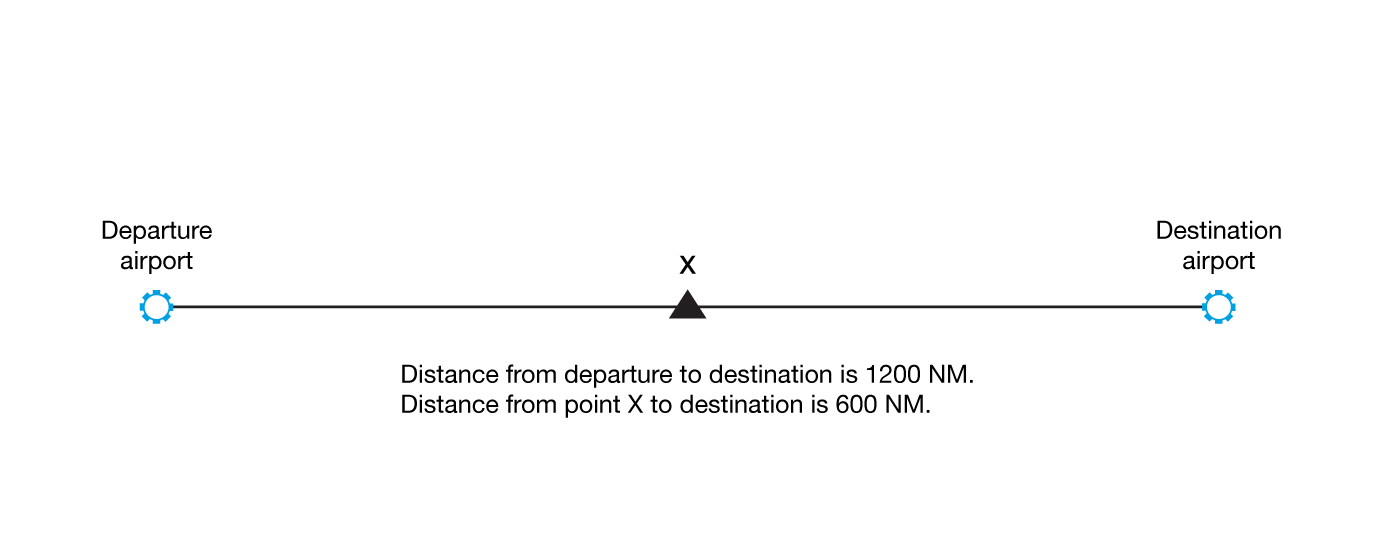
Refer to figure.
Given:
True Air Speed (TAS): 350 kt
Head Wind (HWC): 50 kt
Fuel consumption en-route: 1800 kg/h
Fuel consumption holding: 900 kg/h
Suitable alternate at location: X
Calculate the contingency fuel for a commercial flight with a twin engined jet aeroplane from departure to destination: (Note: The operator is approved for the use of basic fuel scheme WITH variations)
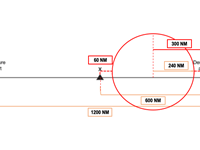
Refer to figure.
First Step: Calculate trip fuel
TAS: 350 kt
HWC: 50 kt
Therefore, Ground speed = 300 kt
To cover a distance of 1200 NM at a groundspeed of 300 kt => it will take 1200 / 300 = 4 hours
Fuel consumption: 1800 kg/h
TRIP FUEL:
1800 kg/h x 4 = 7200 kg
Second Step: Find out if “X” is in fact an ERA or not.
Now, this question can be tricky, we will have to refer to both AMC1 and AMC2 regulations. AMC2 in order to find out if “X” meets the required criteria in order to be considered an ERA (so we can decide if we can reduce contingency to 3% or not).
AMC6 CAT.OP.MPA.181 Fuel/energy scheme — fuel/energy planning and in-flight re-planning policy — aeroplanes BASIC FUEL SCHEME WITH VARIATIONS — CONTINGENCY FUEL (c) The contingency fuel should be the fuel described in points (c)(1) or (c)(2) of this AMC, whichever is higher: (1) an amount of fuel that should be either: (i) not less than 3 % of the planned trip fuel, or in the event of in-flight re-planning, 3 % of the trip fuel for the remainder of the flight provided that a fuel en route alternate (fuel ERA) aerodrome is available; or or (2) an amount of fuel to fly for 5 minutes at holding speed at 1 500 ft (450 m) above the destination aerodrome in standard conditions. |
BASIC FUEL SCHEME WITH VARIATIONS — LOCATION OF THE FUEL EN ROUTE ALTERNATE AERODROME TO REDUCE CONTINGENCY FUEL TO 3 % The fuel en route alternate (fuel ERA) aerodrome should be located within a circle with a radius equal to 20 % of the total flight plan distance; the centre of this circle lies on the planned route at a distance from the destination aerodrome equal to 25 % of the total flight plan distance, or at least 20 % of the total flight plan distance plus 50 NM, whichever is greater. All distances should be calculated in still‑air conditions (see Figure 1). The fuel ERA aerodrome should be nominated in the operational flight plan. |
| Considering the above we have: |
| “The fuel ERA aerodrome should be located within a circle having a radius equal to 20% of the total flight plan distance” RADIUS: 1200 NM x 20% = 240 NM |
| “the centre of which lies on the planned route at a distance from the destination aerodrome of 25% of the total flight”: 1200 NM x 25% = 300 NM |
| “or at least 20% of the total flight plan plus 50 NM”: 1200 NM x 20% + 50 = 290 NM, |
| whichever is greater. DISTANCE FROM DESTINATION: 300 NM |
=> REFER TO FIGURE
We take 300 NM from the destination aerodrome – that will be the centre of our circle of 240 NM radius => we can conclude that the centre of the circle will be located 900 NM (1200 – 300) from the departure aerodrome.
We get ERA “X” located at 660 NM (900 – 240) from Departure aerodrome.
Actual “X” is situated at only 600 NM.
Therefore, we can conclude that “X” CANNOT be considered an ERA - which means we can’t reduce contingency to 3% and instead we must take 5% contingency.
CONTINGENCY: 5% x 7200 kg = 360 kg.
*For Contingency fuel (WITH variations), the regulations actually require you to use the lowest of;
- 3% trip fuel (when an ERA is available)**,
- 20 minutes fuel (cruise fuel flow) – Strongly indicated that this is NOT EXAMINED
- a statistical method of analysis for previous contingency fuel used, approved by the authority. - NOT EXAMINED
Then compare that to
- 5 minutes holding fuel
And take the higher value of the two.
**If an ERA is not available then, in lieu of any other examinable method, and in line with the legal framework of the syllabus, then 5% would then have to be used instead of 3%, and this makes sense as the requirements to use "variations" cannot be met, so basic fuel scheme must be fallen back upon.
Your Notes (not visible to others)
This question has appeared on the real examination, you can find the related countries below.
-
Poland3
-
United Kingdom2
-
Austro Control1
-
Czech Republic1
-
Germany1
-
Ireland1
-
Italy1
-
Norway1
-
Switzerland1


 Use Keyboard Shortcuts
