

Air data information is output from an Air Data Computer (ADC) to various aircraft systems. Which of the following options correctly describes valid ADC outputs and their purpose.
1. Angle of attack for flight envelope protection
2. Radio height above terrain for EGPWS computations
3. CAS for the PFD to display the airspeed
4. Pressure altitude for the autopilot and flight director to maintain a selected flight level
5. Mach number used by EGPWS
6. TAS for the INS to compute groundspeed
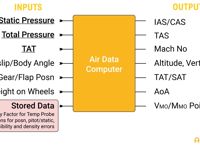
Refer to figure.
EASA learning objective 022.02.08.01.03 states: 'List the following possible output data, as applicable to aeroplanes or helicopters: IAS; TAS; SAT; TAT; Mach number; AoA; altitude; vertical speed; VMO/MMO pointer.
EASA learning objective 022.02.08.01.05 states: 'Give examples of instruments or systems which may use ADC output data.'
An air data computer (ADC) acts as a central processing point for all the aircraft instruments and systems that need air data parameters in a digital format. Total pressure, static pressure, temperature and angle of attack are input from their respective probes and the ADC performs the necessary calculations to output such parameters as TAS, CAS, altitude, vertical speed and SAT in a digital format that can be processed by the aircrafts systems that require it, this includes INS/IRS which needs a TAS input for wind velocity calculation.
ADC Inputs:
• Total pressure (Required)
• Static pressure (Required)
• TAT/RAT (Required)
• Angle of Attack (Optional)
• Weight on wheels (Optional)
• Flap/Slat posn (Optional)
• Landing gear posn (Optional)
• Sideslip/Body angle (Optional)
• Stored aircraft data (Recovery factor, Posn error etc)
Possible ADC Outputs:
• IAS/CAS
• TAS
• SAT
• TAT
• Mach no
• Angle of Attack
• Altitude
• Vertical speed
• VMO/MMO pointer
Parameters such as AoA and TAT can be outputs as well as inputs because aircraft systems requiring this information will obtain it from the ADC rather than having a separate inputs from the probes.
1. Angle of Attack for flight envelope protection → CORRECT. If fitted, Angle of Attack probes will input AoA information to the ADC from where it can be output to flight envelope protection systems.
2. Radio height above terrain for EGPWS computations → INCORRECT. Radio altitude is not an air data parameter, the ADC is not fed with and does not output height information from a radio altimeter.
3. CAS for the PFD to display the airspeed → CORRECT. Total and static pressure inputs to the ADC together with position error information enable the ADC to output CAS to the PFD.
4. Pressure altitude for the autopilot and flight director to maintain a selected flight level → CORRECT. Flight levels are pressure altitudes, the ADC has a static pressure input to enable it to output barometric altitude information for use by the automatic flight control system.
5. Mach number used by EGPWS → CORRECT. EGPWS uses airspeed outputs from the ADC, including Mach No, for terrain closure calculations
6. TAS for the INS to compute groundspeed → INCORRECT. An INS calculates groundspeed by the integration aircraft acceleration, it requires no external input to do so. TAS is fed to an INS from the ADC to enable it to calculate wind velocity.
Note: The wording of the answer options is based on limited feedback, if you encounter this question with different wording then please let us know.
Your Notes (not visible to others)
This question has appeared on the real examination, you can find the related countries below.
-
France73
-
Austro Control18
-
Germany6
-
Greece6
-
Italy4
-
Finland3
-
Norway3
-
Portugal2
-
Czech Republic1
-
Hungary1
-
Latvia1
-
Netherlands1
-
Poland1
-
Romania1
-
Spain1
-
Switzerland1


 Use Keyboard Shortcuts
