

How is the heat of the Earth predominantly transferred upwards and exits the atmosphere?
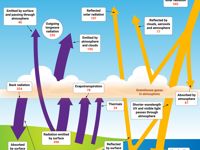
Refer to figure.
Insolation
The Sun provides the energy that heats the Earth and its atmosphere by a process of insolation (incoming solar radiation). Approximately half of the total radiation reaches, and is absorbed by, the Earth’s surface with the rest being absorbed by the atmosphere or re-radiated into space by scattering and reflection.
Terrestrial Radiation
The Earth radiates energy into the atmosphere in the form of terrestrial radiation. It is more readily absorbed by the atmosphere especially by clouds, water vapour and carbon dioxide that solar radiation due to its longer wavelength. The absorption of heat by the atmosphere from the Earth is the main heat exchange mechanism that causes weather. Any terrestrial radiation not absorbed or reflected by the atmosphere escapes back into space.
SUMMARY
Insolation: sun warms the Earth;
Radiation: Earth loses heat, radiates heat.
- During the day, insolation predominates over radiation; hence Earth gets warmer. At night, radiation predominates; Earth cools down. On the average, however, (within a year) insolation and radiation are approximately in balance but it fluctuates during a year (seasonal).
Your Notes (not visible to others)
This question has appeared on the real examination, you can find the related countries below.
-
Austro Control8
-
United Kingdom5
-
Romania4
-
Germany2
-
Greece2
-
Sweden2
-
Belgium1
-
Czech Republic1
-
Ireland1
-
Latvia1
-
Lithuania1
-
Luxembourg1


 Use Keyboard Shortcuts
