

Cold pools...
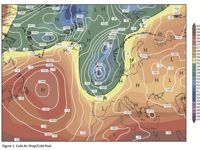
Refer to figure.
COLD AIR DROP/COLD POOL
A cold pool is a low pressure system, that only exists in the upper troposhere - it’s a cooler-than-normal pocket of air in the higher levels of the atmosphere.
As a parcel of air at the surface warms up during the day - it wants to rise. This happens because warmer air is less dense/more buoyant than the cooler air around it. As it rises, the parcel of air cools off. However, when a "cold pool aloft" exists, the parcel that began rising from the surface wants to continue rising through the cold pool. Even though the parcel was cooling as it was rising, it still remains relatively warmer than the cold pool and wants to continue its upward journey. With these air parcels being allowed to continue rising, it induces more cloud development and rain/thunderstorm potential. This is why cold pools aloft are often associated with deep instability and the severe weather associated with vigorous convection is possible.
CHARACTERISTICS
- Cold pools are a challange for the weather forecast, because the numerical weather prediction models cannot predict the exact direction of movement.
- Would be indicated by the low contour (isohypse) height on the 500 hPa chart and higher and the surface chart may show high pressure.
- The weather associated with a cold pool will typically be convective especially over land in summer when thunderstorms can be expected.
- If associated with a static high pressure area such as the Siberian High, a cold pool could be present for weeks. But, in the area of the polar front, the weather systems usually move from West to East in a series of waves and, like the polar front depressions, their duration will be only a few days. => On average cold pools persists for approximately 3 days.
Your Notes (not visible to others)
This question has appeared on the real examination, you can find the related countries below.
-
Austro Control4
-
Azerbaijan4
-
Spain4
-
Sweden1
-
Thailand1


 Use Keyboard Shortcuts
