

The most dangerous icing conditions are encountered in…
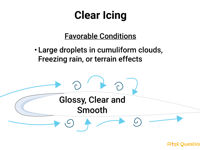
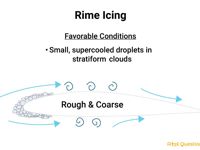
Refer to figures.
Structural Icing
It builds up on any exposed surface of an aircraft, causing loss of lift, an increase in weight, and control problems.
There are 2 general types of structural icing:
RIME ICE
- Normally encountered in stratiform clouds. In these clouds, continuous icing can be expected in the temperature range from 0°C to -30°C, and results from instantaneous freezing of small supercooled water droplets striking the aircraft’s surface.
- It has an opaque appearance caused by air being trapped in water droplets as they freeze. Because it freezes instantly, it builds up on the leading edge of airfoils and it does not flow back over the wing.
CLEAR ICE
- Can develop in areas of large water droplets that are found in cumulus clouds or in freezing rain beneath a warm front inversion. In this case, the droplets flow over the aircraft structure and slowly freeze (they can glaze the aircraft’s surface).
- Clear icing is most heavily concentrated in cumuliform clouds (dense clouds) in the range of temperature from 0°C to -15°C. However, you can encounter clear icing in Cumulonimbus clouds with temperatures as low as -25°C. In addition, supercooled water and icing have been encountered in thunderstorms as high as 40 000 ft, with temperatures of -40°C.
- Clear ice is the most serious of the various forms of ice because it has the fastest rate of accumulation and is more difficult to remove than rime ice.
Freezing Rain occurs when precipitation, in the form of rain, passes from a warm air mass into a relative cold air mass of an air temperature less than 0°C. The rain maintaining its liquid state in sub-zero temperatures renders it super-cooled. These supercooled water droplets freeze when they come into contact with the ground or other exposed surface, if the surface temperature is below 0°C
Freezing Rain can cause significant accumulations of clear ice
Note: You are least likely to encounter icing in high clouds, because these clouds consist of ice crystals and this already-frozen moisture will not adhere to your airframe.
Icing might also occur as a mixture of both rime and clear.
| TEMPERATURE RANGE | TYPE OF ICING | |
| RIME ICE (Small supercooled water droplets Stratiform clouds) | 0°C TO -15°C -15°C TO -30°C | Expect moderate icing Expect light icing |
| CLEAR ICE (Large supercooled water droplets Cumuliform clouds) | 0°C TO -15°C May be found in CB’s at -25°C | Expect severe icing |
Your Notes (not visible to others)
This question has appeared on the real examination, you can find the related countries below.
-
United Kingdom2


 Use Keyboard Shortcuts
