

In maritime tropical air in mid-latitudes…
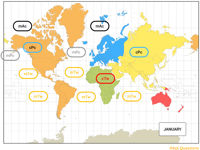
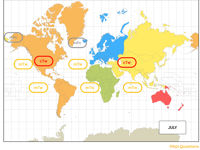
Refer to figures.
The Maritime Tropical (mTw) is the most important moisture-bearing and rain-producing air mass throughout the year.
In winter it moves poleward and is cooled by the ground surface. Consequently, it is characterized by fog or low stratus or stratocumulus clouds, with drizzle and poor visibility.
In summer the characteristics of the mTw air mass over the oceans and in zones of cyclonic activity are basically the same as in winter. Over warm continental areas, however, the air mass is strongly heated so that, instead of fog and low stratus clouds, widely scattered and locally heavy afternoon thunderstorms occur.
Further info on Air Masses:
Air masses are classified according to moisture content, source or type and temperature using a 3-letter system:
First letter - moisture content:
Continental (c)
Maritime (m)
Second letter - source region or type (latitude/temperature):
Equatorial. (E)
Tropical. (T)
Polar. (P)
Arctic. (A)
Third letter: temperature, c(old) or w(arm)
Hence the 5 air masses affecting Europe are:
| AIR MASS | SOURCE | CHARACTERISTICS |
| Arctic maritime, mAc | Polar ice cap. Only experienced during NH winter | stable very cold and dry. |
| Polar maritime, mPc | Northwest area of North Atlantic | stable, cold, absolute humidity low, relative humidity high |
| Polar Continental, cPc | Siberia (winter only) northern Russia | Stable, very cold and dry. it is typically colder than the Arctic maritime air |
| TROPICAL MARITIME, mTw | The Azores anticyclone | Warm, stable, absolute humidity high, RH high. |
| Tropical continental, cTw | N Africa/SE Europe | warm, dry, stable. |
Your Notes (not visible to others)
This question has appeared on the real examination, you can find the related countries below.
-
Poland2
-
Azerbaijan1


 Use Keyboard Shortcuts
