

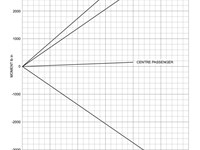
Refer to figure or CAP758 figure 2.16.
Given the following information, calculate the Take Off Mass (TOM) and lateral TOM Centre of Gravity (CG):
BEM: 1 123 lb
Lateral CG: +0.4 in
Pilot: standard mass value in accordance with EASA AIR OPS
Female centre passenger: 80 kg
Male RH passenger: 98 kg
Fuel: 158 lb
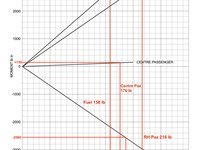
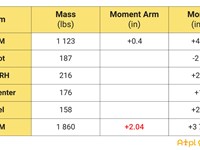
Refer to figures.
To calculate the position of the Centre of Gravity (CG), the mass and the arm of the stations in the helicopter must be known. We can find out the total Centre of Gravity position by adding the total moments and the total masses on board, thereafter, using the formula:
- Moment = Mass x Arm
In accordance with AMC2 CAT.POL.MAB.100(d) Mass and balance, loading. The standard mass value for the pilot is 85 kg.
The question is asking for the lateral CG at TOM and therefore, we need to extract the individual moments from the attached figure:
- Convert the weights given in KG to lbs by factor of 2.205.
- Draw a line from the line showing mass up the individual masses line.
- Thereafter, draw a line to the left to reach the moment of that mass.
Repeat the process for each individual weight and then make a table with the weights and moments as shown in attached figure.
The TOM is:
- TOM = BEM + Pilot + centre Pax + RH pax + Fuel = 1 123 lbs + 187 lbs + 176 lbs + 216 lbs + 158 lbs
- TOM = 1 860 lbs
Find out the TOM moment by adding them and thereafter, calculate the lateral CG by:
- CG = TOM Moment / TOM mass
- CG = +3 799.3 lbs in / 1 860 lbs = 2.04 in
NOTES:
- The negative value of the arm shows that the CG is to the laterally to left of the datum and longitudinally aft of the datum. This is a standard way of calculating the CG in aviation.
- It’s important to draw the lines as accurate as possible to get the most accurate value.
Your Notes (not visible to others)
This question has appeared on the real examination, you can find the related countries below.


 Use Keyboard Shortcuts
