

When the Centre of Gravity of a helicopter is on the forward limit, the results will be a/an (1) _____ in total drag, a/an (2) _____ in range and may run out of (3) _____ cyclic.
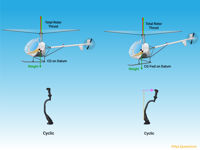
Refer to figure.
The total mass of the helicopter can be said to act through one point called Centre of Gravity (CG).
1. A forward CG results in a nose-down fuselage attitude, increasing its drag and horizotal stabiliser's aerodynamic load, producing an even greater downforce.
The helicopter trying to counteract the increased drag and the increased stabiliser's downforce, will demand more thrust and power, thus decreasing its range (total distance covered), endurance (total airborne time) and rate of climb capability, and increasing its specific fuel consumption.
If the CG is too far forward, there may be insufficient aft cyclic to hold the helicopter in a given position, particularly in the hover. It may be unable to flare, thereby increasing the landing distance and it may be impossible to achieve a level-skid landing, causing damage to the skids.
2. An aft CG will reduce drag, the stabiliser will be less loaded, thus the range, endurance and rate of climb capability will increase, and its specific fuel consumption will decrease.
However, with aft CG, the forward cyclic required for high speed thrust is more, increasing the bending moment on the rotor mast.
If the CG is too far aft, there may be insufficient forward cyclic to prevent the tail rotor and boom from striking the ground. Wind is also a factor, because blowback requires forward cyclic and this may already be at its forward limit.
Your Notes (not visible to others)
This question has appeared on the real examination, you can find the related countries below.
-
Austro Control1
-
Italy1


 Use Keyboard Shortcuts
