

At which airspeed is the minimum rate of descent flown during autorotation?
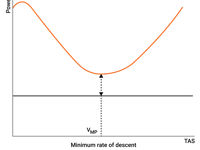
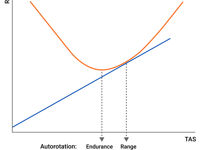
Refer to figures.
Manufacturers usually publish a Rate of Descent/TAS graph, which is equivalent to Power required/TAS, indicating the best speeds for autorotation.
The minimum RoD is found at the lowest point of the Power/TAS or RoD/TAS curves, where power available is less than the power required and the power deficit is the smallest. The corresponding speed is the maximum endurance speed or best rate of climb speed (VY) or minimum power required speed (VMP) and is less than the best range speed for autorotation.
The purpose of autorotating with the minimum RoD is to give the Pilot the maximum airborne time to deal with the emergency condition, by descending as slowly as possible and along the shallowest flight path.
The minimum RoD speed, VY, should be combined with rotor speed within limits, because a lower than normal rotor speed would have a converse effect, increasing the RoD.
Low rotor speed, by raising the collective, may be combined with the maximum range speed for autorotation to achieve absolute maximum range. But this technique carries the risk of inadvertently reducing rotor RPM below the minimum sustainable rotor speed.
Your Notes (not visible to others)
This question has appeared on the real examination, you can find the related countries below.
-
France1


 Use Keyboard Shortcuts
