

What is the definition for the OEI Service Ceiling?
-
A
The altitude with OEI at which the rate of climb diminishes below the specific rate.
-
B
The altitude with AEO at which the rate of climb diminishes below the specific rate.
-
C
The altitude with OEI at which the rate of climb diminishes below 50 ft/min.
-
D
The altitude with OEI at which the rate of climb drops to zero.
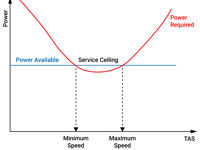
Refer to figure.
As altitude increases:
- The power required line moves up and expands to the right, and
- The power available line moves down.
Where there is an excess of power available over power required, a helicopter will be able to climb, until the point at which the rate of climb (ROC) drops at a specific value depending on the helicopter type. This specific value of ROC determines the altitude of the "service ceiling".
For multi-engined helicopters, the service ceiling is either All Engines Operating (AEO) ceiling, or OEI (One Engine Inoperaitve) ceiling.
Following an engine failure, the power available is almost halved. This dramatically reduces the altitude at which the rate of climb diminishes below the specific rate. This altitude is the "OEI Service Ceiling" and a limited range of speeds occurs.
For a Twin Engine Turbine Helicopter (TETH), according to CAP 758 Figures 3.15 and 3.16, the service ceiling for both All Engines Operating and One Engine Inoperative is the altitude where the margin between power available and power required permits a rate of climb not more than 150 ft/min flying with VY(top left corner of each graph).
NOTE:
The altitude at which the rate of climb reduces to 0 ft/min is called "absolute ceiling", where the power required and power available curves are tangential to each other (Power required = Power Available) and there is only one speed for straight and level flight.
Your Notes (not visible to others)
This question has appeared on the real examination, you can find the related countries below.
-
Austro Control4
-
France3
-
Spain2
-
United Kingdom2
-
Bulgaria1
-
Germany1
-
Italy1


 Use Keyboard Shortcuts
