

In the “Height Velocity (H/V) Diagram”, the avoid areas define the height/velocity combination...
-
A
From which a safe climb-out may not be made, with regard to obstacle clearance.
-
B
In which it is possible only to make forward (as opposed to sideways or rearwards) translational flight.
-
C
From which safe autorotative descent and landing after engine failure may not easily be accomplished.
-
D
From which it is not possible to operate the helicopter due to the engine being power limited.
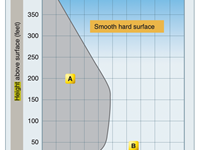
Refer to figure.
Aircraft manufacturers make certain assumptions when developing performance charts:
- Assumed are certain atmospheric conditions as well as certain aircraft configurations
- Assumed is also a certain ability of the pilot in executing manoeuvre as stated in the performance charts
- Not all flight conditions shown on a chart are actually flight tested
- Rather, averages are established to allow for specific variations
The H/V Diagram:
- Shows the grey areas (A and B in the figure) to avoid operating a helicopter in.
- In regards to engine failures, recovery may not be possible if operating in the grey areas.
- Note that density altitude, pilot ability, gross weight and other factors may stretch or skew the grey areas slightly
- They are not meant as fixed and hard rules.
- Some operations require to be within the grey areas, this is considered calculated risk and must be evaluated in each instance by the Pilot In Command to make the decision if he/she is capable and willing to take that risk.
Your Notes (not visible to others)
This question has appeared on the real examination, you can find the related countries below.
-
Spain2


 Use Keyboard Shortcuts
Use your keyboard for faster navigation
