

What happens to the bus bar loads when the associated generator fails?
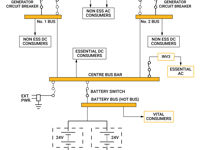
Refer to figure.
In most types of aircraft, the output from the generating sources is coupled to one or more low impedance conductors referred to as bus bars.
The bus bars are the collection and distribution centre for a generator or alternator power supply. They use solid copper bars which can be drilled to permit supply and distribution cables to be attached to them.
Bus bars are usually situated in junction boxes or distribution panels located at central points within the aircraft, and they provide a convenient means for connecting power supplies to the various consumer circuits.
Each generator has its own bus bar which are connected the non-essential consumer services. In the event that one generator should fail it is automatically isolated from its respective bus bar and all bus bar loads are then taken over by the operating generator.
Your Notes (not visible to others)
This question has appeared on the real examination, you can find the related countries below.
-
France42
-
United Kingdom7
-
Italy5
-
Portugal5
-
Spain4
-
Germany3
-
Greece2
-
Poland2
-
Sweden2
-
Czech Republic1


 Use Keyboard Shortcuts
