

The wing ice protection system currently used on most large jet transport aeroplanes is…
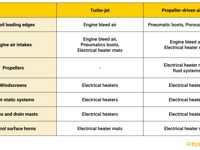
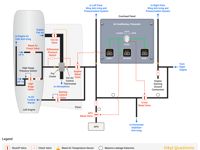
Refer to figures.
ICE CONTROL SYSTEMS
Two major categories of ice control systems are pneumatic boots – which expand and break ice off aerofoils; and thermal systems – which use bleed air or electricity to heat protected surfaces and prevent ice.
AEROFOIL ICE CONTROL
To protect wing and tail surface leading edges from icing, most aeroplanes use pneumatic devices. On many reciprocating-engine and turboprop airplanes, de-icing boots are pneumatically inflated to break the ice, which allows it to be carried away by the airstream. In another system, primarily used by turbine-powered aeroplanes, heated air is directed through ducting in the aerofoil leading edge, to thermally prevent ice from forming. This is referred to as thermal anti-ice system.
- Thermal Anti-ice Systems
Thermal anti-ice systems heat the surfaces on aeroplanes to prevent ice formation. Hot air anti-ice systems are installed on some turbojet and turboprop aeroplanes. This is because a turbine engine has a ready source of hot air that can be used to heat aerofoil leading edges. In this system, air is diverted “bled” from one of the later stages of the compressor section of the engine and piped through ducts to the leading edges of the aerofoil to be protected. Engine inlets can also be protected with hot bleed air, or can be electrically heated.
Your Notes (not visible to others)
This question has appeared on the real examination, you can find the related countries below.
-
Austro Control7
-
Hungary2
-
Poland2
-
Spain2
-
Greece1
-
Latvia1
-
Pakistan1
-
Portugal1
-
Romania1
-
Sweden1


 Use Keyboard Shortcuts
