

The accessory gearbox of a modern turbofan engine is usually driven by...
-
A
the high-pressure compressor through a drive shaft. It has its own lubrication system
-
B
the high-pressure compressor through a drive shaft. It is connected to the lubrication system of the engine.
-
C
bleed air from the high-pressure compressor. It has its own lubrication system
-
D
bleed air from the high-pressure compressor. It is connected to the lubrication system of the engine.
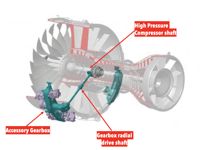
Refer to figure.
Learning Objective 021.11.03.04.02: Describe how the gearbox is driven and lubricated.
The accessory drive is a gearbox that forms part of a gas turbine engine. Although not part of the engine's core, it drives the accessories like fuel pumps, oil pumps, generators, hydraulic pumps, etc. The accessory gearbox is commonly driven by the high pressure shaft, via a gearbox radial drive shaft.
It is good to remember that the "accessory gearbox" is the main gearbox, also called the auxiliary gearbox. It is NOT the same as the secondary gearbox which is fitted to some engines, which is driven by the low pressure shaft.
Like all the other engine’s moving parts, oil from the engine is used to lubricate and clean the accessory gearbox elements. This is done because they are so close together and the oil requirements are similar, so the same oil is used for both, to reduce complexity and the need for two separate oil cooling, pump and storage systems.
Your Notes (not visible to others)
This question has appeared on the real examination, you can find the related countries below.
-
Spain11
-
Greece7
-
United Kingdom7
-
Austro Control6
-
Czech Republic5
-
Germany5
-
Poland4
-
Romania4
-
Slovakia4
-
Ireland3
-
Sweden3
-
Switzerland3
-
Hungary2
-
Norway2
-
Cyprus1
-
Denmark1
-
Finland1
-
Latvia1
-
Malta1


 Use Keyboard Shortcuts
