

An aircraft on a track of 046°(M) has to fly over an obstacle of 4600 ft with a clearance of 1000 ft. The QNH is 990 hPa and the temperature is ISA +15°C. What is the minimum safe flight level at which the aircraft may fly? Assume 30 ft per hPa.
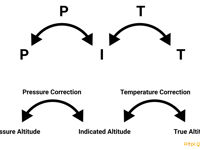
Refer to figure.
The aircraft must fly at 5600 ft (4600 ft + 1000 ft). This altitude must be the true altitude of the aircraft. This altitude must be corrected for any temperature ISA deviation and then any difference in pressure from standard (1013 hPa), to get the pressure altitude, allowing us to work out the lowest usable flight level.
The first step is to determine the temperature correction. The ISA deviation is ISA +15°C. Based on the 4% rule and its calculation mentioned in the rules below, the height correction for the temperature can be calculated as follows: Height correction for temperature = 4 × (+15) × (5600/1000) = 336 ft.
In this case, the temperature correction is subtracted from the true altitude as per the rules below (refer to the table below), to give an indicated altitude of 5264 ft.
Next, we need to compute the pressure correction by considering the deviation from the standard mean sea level pressure of 1013 hPa: 1013 hPa - 990 hPa = 23 hPa. Since the barometric lapse rate near the surface is 30 ft/hPa, the pressure correction can be calculated as follows: Pressure correction = 23 hPa x 30 ft/hPa = 690 ft. This value needs to be added to the indicated altitude as per the rules below:
Pressure Altitude = 5264 ft + 690 ft = 5954 ft.
According to the ICAO IFR Semi-Circular Rule, below FL290:
- For Easterly magnetic tracks (000° - 179°), select ODD FLs (FL110, FL130, etc.)
- For Westerly magnetic tracks (180° - 359°), select EVEN FLs (FL100, FL120, etc.)
The aircraft flies a north-easterly magnetic track of 046°(M). Thus, the Minimum Flight Level, which provides obstacle clearance, after both pressure and temperature correction, that must be selected is: FL70.
RULES. The following rules should be considered for altimetry calculations:
- All calculations are based on rounded pressure values to the nearest lower hPa.
- The value for the barometric lapse rate between MSL and 500 hPa to be used is 30 ft/hPa as an acceptable approximation of the barometric lapse rate.
- To determine the true altitude/height, the following rule of thumb, called the ‘4%-rule’, shall be used: the altitude/height changes by 4% for each 10°C temperature deviation from ISA.
For simplification: Height correction for the temp = 4 × (ISA DEV) × Indicated alt/1000 = _____ ft - If no further information is given, the deviation of the outside-air temperature from ISA is considered to be the same throughout the whole layer.
- The elevation of the aerodrome has to be taken into account. The temperature correction has to be considered for the layer between the station (usually an aerodrome) and the position of the aircraft.
IF | THEN |
| Higher pressure | Indicated Altitude > Pressure Altitude |
| Lower pressure | Indicated Altitude < Pressure Altitude |
| Warmer than ISA | True Altitude > Indicated Altitude |
| Colder than ISA | True Altitude < Indicated Altitude |
Definitions
Pressure Altitude: The altimeter indication with standard pressure (1013.2 hPa) set.
Indicated Altitude: The altimeter indication with local QNH set.
True altitude: The actual altitude of the aircraft above mean sea level.
Your Notes (not visible to others)
This question has appeared on the real examination, you can find the related countries below.
-
Austro Control8
-
Germany3
-
Ireland2
-
Spain2
-
Switzerland2
-
Czech Republic1
-
Iceland1
-
Italy1
-
Sweden1
-
United Kingdom1


 Use Keyboard Shortcuts
