

Refer to figure.
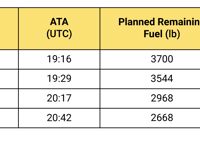
Given the information in the Flight Log excerpt, calculate the actual fuel consumption rate from BRAVO to DELTA, provided that the flight conditions on the flight legs from BRAVO to CHARLIE and the fuel consumption remain unchanged.
Refer to figure.
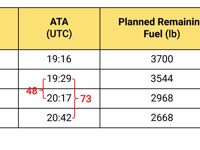
For this question, the actual fuel consumption from BRAVO to DELTA can be found using the actual data from BRAVO to CHARLIE, since the flight conditions on the flight legs from BRAVO to DELTA and the fuel consumption remain unchanged:
- The actual flight time from BRAVO to CHARLIE is: 20:17 - 19:29 = 48 min and it burns: 3531 lb - 2907 kg = 624 lb.
- Thus, the aircraft's fuel flow is: 624 lb/48 min or 780 lb/h.
Your Notes (not visible to others)
This question has appeared on the real examination, you can find the related countries below.
-
United Kingdom51
-
Spain22
-
Poland19
-
Portugal9
-
Austro Control8
-
Czech Republic7
-
Italy7
-
Greece6
-
Sweden6
-
Bulgaria4
-
Hungary4
-
Luxembourg2
-
Malaysia2
-
Netherlands2
-
Norway2
-
Pakistan2
-
Latvia1
-
Lithuania1
-
Romania1
-
Serbia1
-
Switzerland1
-
Thailand1


 Use Keyboard Shortcuts
Use your keyboard for faster navigation
