

-
A
the rhumb line route between those two positions will change by 30°.
-
B
the rhumb line and great circle route between those two positions will differ by 30° at either position.
-
C
the great circle route between those two positions will change by 30°.
-
D
a straight line drawn between those two positions will change by 30°.
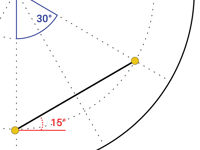
Refer to figure.
The Polar Stereographic Chart Projection is a plane projection and the parallel of origin is the pole. Meridians are straight lines radiating from the pole which cut parallels of latitude at right angles. Parallels of latitude are shown as concentric circles and their distance apart increases away from the pole.
Convergency is how much the Great circle track changes, because of the converging meridians and is correct where the chart is tangential to the reduced Earth, at the pole.
Great circles at the point of tangency would be straight lines, but the tangential point is only a point, so you cannot draw a great circle there. Elsewhere, Great circles will actually be slightly curved concave to the pole, but near the pole can be assumed to be straight lines.
Thus, since the meridians at the two positions converge with an angle of 30°, then the straight line drawn between the two points will change direction by the same amount, 30°.
Your Notes (not visible to others)
This question has appeared on the real examination, you can find the related countries below.
-
France42
-
United Kingdom27
-
Spain20
-
Austro Control19
-
Germany13
-
Greece13
-
Portugal9
-
Poland7
-
Czech Republic5
-
Finland4
-
Ireland4
-
Lithuania4
-
Azerbaijan3
-
Italy3
-
Bulgaria2
-
Latvia2
-
Norway2
-
Serbia2
-
Denmark1
-
Iceland1
-
Romania1
-
Slovakia1
-
Thailand1


 Use Keyboard Shortcuts
