

In order to completely resynchronise with local time after zone crossing, circadian rhythms require…
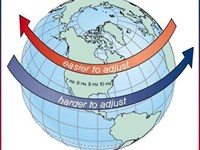
Refer to figure.
TIME ZONE CROSSING
Crossing time zones is a way of life for long-haul aircrew, and the time zone shifts can lead to a cumulative sleep deprivation. The shifting of zeitgebers will help to resynchronize to the new local time but it is a slow process, averaging a shift of about 90 minutes for each day in the new time zone.
Effects of Direction on Recovery – East or West, which is best?
- Travelling Westwards: London – New York
New York is 5 hours behind London, so noon occurs 5 hours later. This means that an aircrew will experience a 29 hour day. However, our free-running body clock is 25 hours, which means that the crew will suffer from 4 hours jet lag. - Travelling Eastwards: New York – London
London is 5 hours ahead of New York so noon occurs 5 hours earlier. This means that an aircrew will experience a 19 hour day. However, our free-running body clock is 25 hours which means that the crew will suffer from 6 hours jet leg.
=> Jet Lag after travelling westwards is less than Eastwards. Travelling east causes more problems than travelling west. Most people have an endogenous circadian rhythm that is longer than 24 hours, so lengthening a day is less troublesome than shortening it.
Your Notes (not visible to others)
This question has appeared on the real examination, you can find the related countries below.
-
Austro Control1


 Use Keyboard Shortcuts
