

Consider two twin-engined, propeller-driven aeroplanes. The propellers on AP1 rotate clockwise, and those on AP2 rotate anticlockwise.
If there's a left engine failure in both aeroplanes, which will give the largest yawing moment, and from which side will it be?
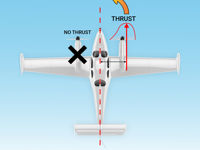
Refer to figure.
When an engine fails on a multi-engine aircraft, there will be a decrease in thrust and an increase in drag on the side of the failed engine. Primarily there will be a yawing moment towards the failed (dead) engine.
The critical engine is the engine which would give the biggest yawing moment if it fails.
One of the factors influencing the yawing moment following an engine failure on a multi-engine aircraft is the length of the thrust arm (i.e., distance from the aircraft's CG to the thrust line of the operating engine).
In case of a propeller engine aircraft, the length of the thrust arm is determined by the asymmetric effect of the propeller. When the aircraft is flying with a positive angle of attack (which is normal), the thrust line of a clockwise rotating propeller (when viewed from the rear) is displaced to the right of the engine centre line. This is because the down-going blade generates more thrust than the up-going blade (P-factor).
If both engines rotate clockwise, the starboard (right) engine will have a longer thrust arm than the port (left) engine. If the left engine fails, the thrust of the right engine acts through a longer thrust arm and will give a larger yawing moment.
If both engines rotate inward, they will have the same (shorter) thrust arm (counter-rotating propellers).
Of course, no matter the direction of the propellers, a failure of the left engine will always produce a yaw to the left, it is just bigger if the aircraft has clockwise rotation propellers.
Note: Although this question is not part of the instrumentation syllabus, it was added to the database because of student feedback. If you find this question in your INSTRUMENTATION exam, you should appeal.
Your Notes (not visible to others)
This question has appeared on the real examination, you can find the related countries below.
-
Austro Control2
-
France2
-
Switzerland2
-
Czech Republic1
-
Greece1
-
Lithuania1
-
Luxembourg1
-
Spain1


 Use Keyboard Shortcuts
