

In the northern hemisphere, during a take-off run in a westerly direction, a direct reading magnetic compass indicates:
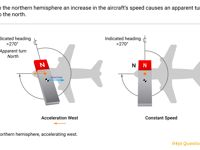
Refer to figure.
EASA learning objective states: 'Describe how the direct-reading magnetic compass will only show correct indications during straight, level and unaccelerated flight, and that an error will occur during the following flight manoeuvres (no numerical examples): acceleration and deceleration; turning; during pitch-up or pitch-down manoeuvres.'
The direct reading compass is subject to acceleration/deceleration and turning errors. Therefore, you can only have accurate indications in straight and level unaccelerated flight. The DRC consists of a a magnet mounted on a compass card assembly which is balanced on a pivot in a case filled with clear oil. The edge of the card has a printed scale and, because of the way that it is mounted, you look at the rear of the card so the lubber line represents the tail of the aircraft. For this reason the scale is marked in reverse which gives the illusion of the card moving the wrong way during turns.
At the magnetic equator, where the Earths magnetic field lines are horizontal, the compass assembly will be horizontal which means that its centre of gravity is in line with the pivots axis. Unfortunately as the compass moves closer to the poles the assembly will tilt downwards (dip) towards the nearest pole because of the increasing vertical component of the Earths magnetic field. This tilting or dip displaces the c of g which will cause errors when accelerating or decelerating on Easterly or Westerly headings or when turning though North or South.
The figure shows an aircraft in the Northern Hemisphere on a westerly heading, the compass assembly is represented by a bar magnet for simplicity. The C of G of the magnet is displaced to the south of the pivot due to the dip toward the nearest pole (North!). Acceleration acts through the pivot and the reaction acts in the opposite direction through the C of G. Because the pivot and C of G aren't in line this causes a turning moment which rotates the compass assembly anticlockwise which indicates an apparent turn to the North. Acceleration on an easterly heading will also indicate an apparent turn to the North caused by the compass assembly rotating clockwise. Using the same principle deceleration on a Westerly or Easterly heading will cause an apparent turn to the South. This is only true in the Northern hemisphere, in the Southern Hemisphere the errors are reversed due to the dip being in the opposite direction!
Acceleration or Deceleration on a Northerly or Southerly heading will not cause an error because the line of action of the force is in line with the pivot and the C of G.
So much for the theory! To summarise:
• Acceleration and deceleration errors only occur on Easterly or Westerly headings.
• In the Northern hemisphere acceleration causes an apparent turn to the North and deceleration causes an apparent turn to the South.
• No errors occur at the magnetic equator.
• In the Southern hemisphere the errors are reversed.
Fortunately there is an easy way to remember acceleration and deceleration errors using the mnemonic NANDS:
Northern hemisphere, Accelerate North, Decelerate South
A simple way to visualise which way the compass assembly turns is to use your CRP-5 or E6B inner ring to replicate the compass assembly and the True heading mark on the outer ring to represent the lubber line. For example, if you align West on the inner ring against ‘True Heading’ on the outer ring an indication of an apparent turn to the North requires you to rotate the inner ring in an anticlockwise direction!
Your Notes (not visible to others)
This question has appeared on the real examination, you can find the related countries below.
-
France21
-
Germany3
-
Austro Control2
-
Luxembourg2
-
Poland2
-
Romania2
-
Czech Republic1
-
Lithuania1
-
Qatar1


 Use Keyboard Shortcuts
