

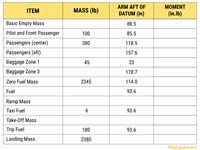
Refer to figure.
Determine the moment of Basic Empty Mass of the aeroplane.
Determine the moment of Basic Empty Mass of the aeroplane.
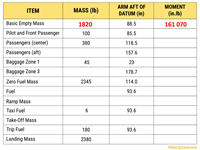
Refer to figure.
The Basic Empty Mass (BEM) is the mass of the aircraft with the basic equipment, unusable fuel and other fluids, lubricating engine oil, fire extinguishers, emergency oxygen equipment and supplementary electronic equipment.
Thus, the BEM is: Zero Fuel Mass (2 345 lb) - Baggage Zone 1 (45 lb) - Passengers (380 lb) - Pilot and Front Passenger (100 lb) = 1820 lb.
Moment is the turning force created by the mass over a distance or lever arm: Moment = Mass x Arm.
Therefore, the moment of the BEM is: BEM Moment = 1820 lb x 88.5 inches = 161 070 lb.in
Your Notes (not visible to others)
This question has appeared on the real examination, you can find the related countries below.
-
Austro Control11
-
Poland7
-
France5
-
Greece5
-
Sweden5
-
Spain4
-
Portugal3
-
Czech Republic1
-
Denmark1
-
Italy1
-
Luxembourg1
-
Romania1
-
Thailand1


 Use Keyboard Shortcuts
Use your keyboard for faster navigation
