

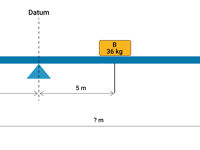
Refer to figure.
In the beam bar of the figure, what should be the distance between the masses A and C to keep the beam bar in balance?
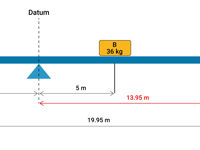
Refer to figure.
In order to maintain the balance, the moment produced by the mass A should be equal to the moment produced by the masses B and C in order to cancel each other out and result in a total moment of zero.
- The moment of the mass A will be MomentA = massA x distanceA = 309 kg x 6 m = 1854 kg m
- The moment of the mass B will be MomentB = massB x distanceB = 36 kg x 5 m = 180 kg m
- The moment of the mass C will be MomentC = massC x distanceC = 120 kg x distanceC
To achieve balance, the following should apply:
MomentA = MomentB + MomentC
1854 kg m = 180 kg m + 120 kg x distanceC
120 kg x distanceC = 1854 kg m - 180 kg m = 1674 kg m
distanceC = 1674 kg m / 120 kg = 13.95 m
Therefore, mass C should be at a distance of 13.95 m from the datum. The distance between masses A and C will be 13.95 m + 6 m = 19.95 m.
Note: A moment is defined as the product of a mass and its balance arm (distance from a reference point).
- Moment = Mass × Balance Arm
Your Notes (not visible to others)
This question has appeared on the real examination, you can find the related countries below.
-
Switzerland1


 Use Keyboard Shortcuts
